Ecosystem map template
Created by:

Understand complex relationships between stakeholders, systems, and touchpoints with a visual framework
Categories
- Product Management
- Network & Relationship Maps
- Whiteboard Template
KEY FEATURES
Stakeholder Alignment
Documentation
Ideation
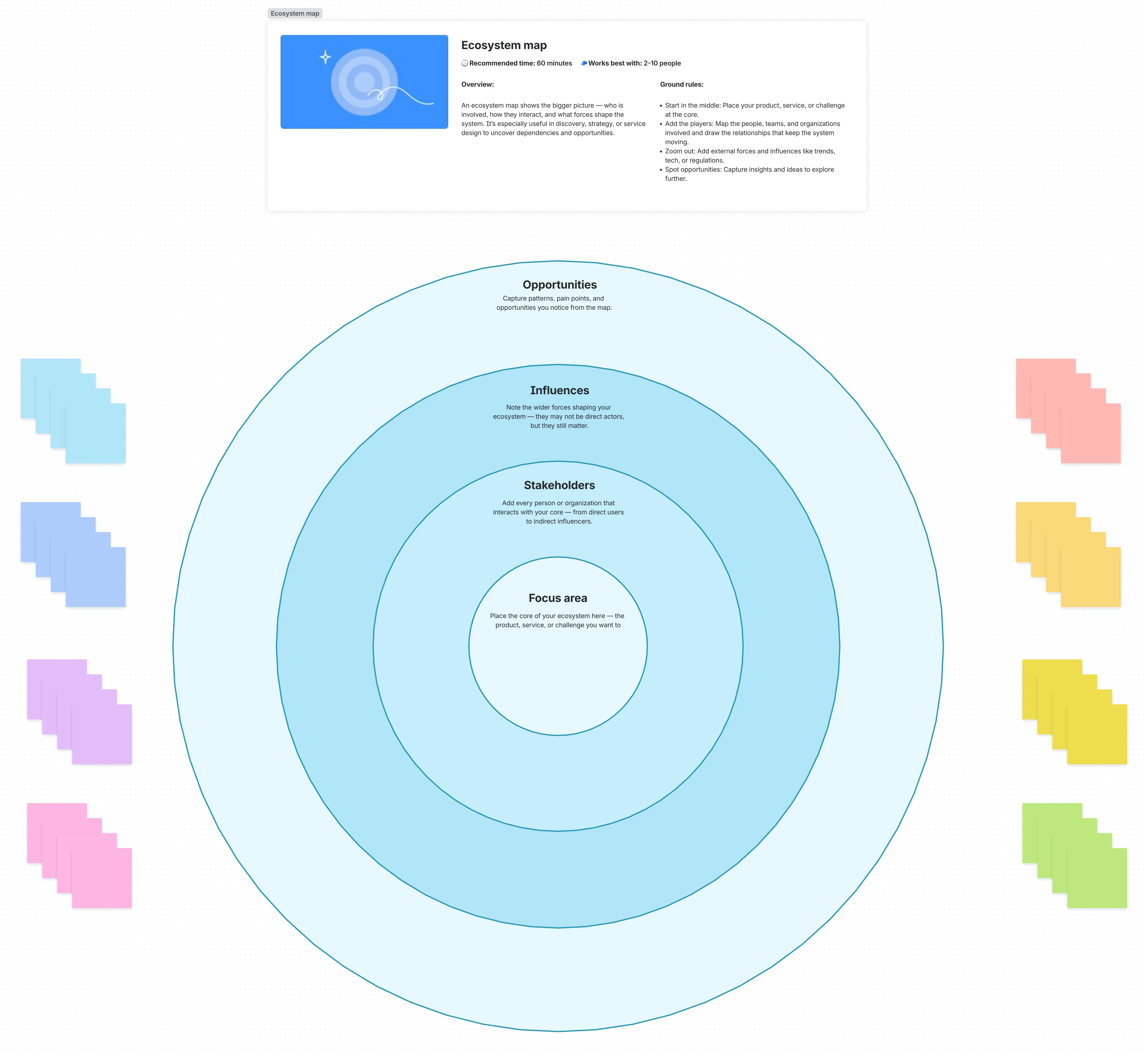
Creating an ecosystem map can feel overwhelming when staring at a blank page. Conversely, a template provides a structured starting point for mapping all the moving parts in your business environment. Whether you're launching a new product, enhancing user experience, or planning a major project, having a clear visual representation of your ecosystem helps teams make more informed decisions and identify opportunities they might have otherwise missed.
Benefits of using an ecosystem map template
Provides a visual representation
Ecosystem map templates help simplify complex systems into a digestible visual layout. This makes it much easier to communicate with stakeholders across different functions who might not be familiar with all the technical details.
Improves team alignment
When everyone can see the same representation, it encourages shared understanding of how different elements interact. This knowledge sharing helps teams stay aligned when planning or executing projects, reducing miscommunication and conflicting priorities.
Reveals gaps and opportunities
Templates make it easier to identify missing connections, duplicate efforts, or inefficiencies that may not be apparent in written documentation. They highlight areas where you can innovate or expand services by showing what's currently missing from your ecosystem.
Supports better decision-making
Having a holistic view guides strategy, investment, and resource planning decisions. When you can see how different parts of your ecosystem connect, you can improve decision-making by being better equipped to make choices that support the whole system rather than just individual components.
Identifies key players and connections
Templates help identify the main stakeholders and systems, making it easier to prioritize engagement and communication based on influence or dependency. This helps you focus your energy on the relationships that matter most.
How to use the ecosystem map template
- 1
Define objectives
Clarify why you're creating the map and what you want to achieve. Your objectives will help you determine the right level of detail and structure for your map.
- 2
Identify key entities
List all individuals, organizations, tools, or processes relevant to your ecosystem. Include both internal and external entities, even if their connection isn't immediately obvious.
- 3
Categorize relationships
To make your map easier to read, group similar entities together based on role or function. Use visual cues, such as colors, shapes, or sections, to distinguish between different categories.
- 4
Map out connections
Draw lines or arrows to represent relationships between entities, and label or annotate connections to show direction, type, or strength. This is where patterns often start to emerge.
- 5
Analyze dependencies and influence
Review your completed map to understand which entities are most interconnected or have the greatest impact. Look for areas of risk, redundancy, or opportunity that may require attention.
- 6
Share and iterate
Present your map to stakeholders and gather feedback to make sure you haven't missed anything important. Revise it as your ecosystem evolves or as you gain new insights.
Use the ecosystem map in Confluence
Confluence simplifies creating and sharing ecosystem maps with your team using built-in online whiteboards and collaborative features.
You can use Confluence's concept mapping tools to build your business ecosystem map template, then easily share it with stakeholders for feedback and collaboration for effective brainstorming sessions where team members can contribute ideas and insights in real-time.
With features designed for project collaboration, Confluence helps teams turn their ecosystem maps into actionable insights. You can link your maps to related documentation, track changes over time, and ensure everyone has access to the most current version.
Explore more templates to supercharge teamwork
Empower everyone, on every team. Build, connect, and deliver your biggest ideas seamlessly across Atlassian apps using our complete collection of ready-made workflows.