Transform teamwork with Confluence. See why Confluence is the content collaboration hub for all teams.Get it free
How to define and create a project scope in 5 simple steps

Key Takeaways
A scope of work is a detailed document that defines the boundaries of a project, including its specific goals, deliverables, tasks, and deadlines.
This document serves as a formal agreement among stakeholders to prevent scope creep and ensure everyone has realistic expectations for the project.
Including clear exclusions and constraints helps the team stay focused on the agreed-upon objectives and avoid unnecessary work.
Review the finalized document with all key stakeholders to secure their formal sign-off before beginning execution.
Defining project scope is the cornerstone of successful project management. It sets clear boundaries around the tasks, timelines, and resources needed to achieve your goals—keeping teams aligned and projects on track, on time, and on budget.
Going to the store for eggs but leaving with a full cart is like letting your project scope grow unchecked—costs and tasks quickly add up. There's a reason why the eggs are always at the back of the grocery store and why scope creep is a common a common pitfall in projects of all sizes.
However, if you clearly outline your project scope from the start, you avoid these costly detours and ensure your team stays focused on what matters most.
This article will clearly define project scope, how to write one, and the steps you need to take to keep your project deliverables on track.
What is project scope?
Project scope defines the boundaries of a project by specifying what’s included, what’s excluded, and how the team will deliver the final outcome. It acts as a roadmap, outlining deliverables, major milestones, and constraints to ensure everyone is aligned from start to finish.
The project scope statement takes all of that and puts it into a clear, shareable document. It’s how you turn the big idea of “scope” into something your team can actually reference, follow, and use to make decisions throughout the project.
Why is project scope important?
Chances are, you’re someone who’s guilty of an unexpectedly large shopping trip or a project that somehow ballooned beyond the initial requirements. According to the Project Management Institute (PMI), a whopping 52% of projects experience the dreaded scope creep.
You don’t have an infinite amount of team members, time, and money. And if your project requirements continue to expand, your resources are going to be strapped.
Effective project scope management keeps you close to your original plan and improves resource management, leading to these benefits:
Realistic timelines
One PwC study found that only 2.5% of companies complete their projects 100% successfully. The rest miss their original budget, deadline or both.
Managing project scope prevents you and your team from blowing past your original end date. When you know exactly what’s required to complete a project, you have a much easier time setting a realistic deadline.

Accurate budgets
It’s tough to understand how much a project will cost if its requirements and deliverables are constantly shifting and evolving.
Defining the scope helps you set a reasonable budget in the first place, and monitoring the scope as your team makes progress will help you stick with that number.
More efficient projects
We’ve all been there. You’re dealing with a project that won’t end because teams or clients keep requesting new features, tweaks, or additions, making the project drag on and on and on.
It feels good to say “yes” to things, but project teams have the tendency to keep agreeing to requests without realizing how far they’ve strayed from the initial plan.
Defining and managing your project scope lets your team to deliver projects efficiently in accordance with the original requirements. To put it simply, your scope—and the project scope statement you create—serves as the project touchstone and keeps things from snowballing.
5 steps to define and write your project scope
You can’t see into the future, so defining your project scope is a real challenge. How are you supposed to know everything your project entails on day one?
Let’s walk through a few steps you can use to create a basic project scope statement.:
1. Determine the ultimate project goals
Every project has an objective—that’s why you’re doing it in the first place.
Another PMI study found 37% of project failures are due to poorly defined objectives and milestones. Don’t assume your end game is common knowledge for everyone on your team.
Defining your goals, like what will the project achieve, provides important context.
In the case of our example project, the goal would be: Create a new client questionnaire that will streamline the intake of new clients and ensure we have all necessary client information from the get-go.
Pointing to your objective at the start makes future steps easier, as you can keep your eye on the project’s main goal and make decisions with it in mind.
2. Define the project deliverables
What tangible thing or things are you creating? In this case, it’s the online questionnaire that will be automatically delivered to your newly contracted clients along with a landing page with more information.
Identifying your deliverables at the start will help you catch when scope creep starts to sneak up.
So if your team suggests adding an online portal for client file submissions, remember it’s not part of this project’s deliverables. It’s best to address it separately after this project is complete and resources are available.
3. Identify all project tasks and activities
In this step, you’re breaking your deliverables down into distinct tasks and activities. What steps do you need to take to produce that deliverable? This is called a work breakdown structure.
To create your new client questionnaire, you’ll need to:
Decide on and draft questionnaire copy
Input the questionnaire into an online form
Create a landing page where clients can access and learn about the questionnaire
Set up an automated email that delivers the questionnaire
The more you split your project into specific, actionable steps, the easier it is identify ad hoc requests or tasks excluded from the original plan. This approach makes a huge and complicated project feel a heck of a lot more manageable.
4. Establish clear project exclusions
Understanding what you won’t do is just as important as understanding what you will. As counterintuitive as it seems, outline the tasks and deliverables you won’t complete as part of this project.
With your questionnaire project, you’ll spell out that you aren’t tackling the following:
Online portal where clients can submit resources and files
Multi-step onboarding email sequence
Tailored questionnaires for each type of client
You’ve probably heard that the best offense is a good defense, and that’s what this step is all about. It’s like you’re posting a “beware” sign for out-of-scope things you think could crop up and make you stray from your goal.
5. Learn and detail the project constraints
You’re not completing this project in fantasy land. There are real-world project constraints (budgets, timelines, and resources) you’ll need to work with. You’ll define those in this step.
Here are a few constraints of your client questionnaire:
It needs to be live by November 25, 2026
Total project budget can’t exceed $5,300
Web development team will not be available to create the landing page until the end of October
You need to be as realistic as possible, so make sure to involve your team members in this process. They’ll have input on other limitations you need to work with.
Project scope statement example
You’ve scribbled out your notes, and you’re ready to pull this all into a project scope statement that you and your team can reference. Make sure you keep it somewhere safe and accessible to everyone (a collaborative project management space like Jira is great for this).
Most of the hard work is behind you, and now you just need to organize the information. At the top of your project scope statement, you’ll include a few nuts and bolts elements like your project’s:
Name
Description
Deadline
Manager
Here’s what the project scope statement for our example project could end up looking like:
Project Scope Statement | |
|---|---|
Project Name: | New Client Questionnaire |
Description: | Automated questionnaire that’s delivered to all new clients after we’ve secured a signed contract |
Deadline: | November 25, 2026 |
Manager: | Isabel |
Goal: | Create a new client questionnaire that will streamline the intake of new clients and ensure we have all necessary client information from the get-go |
Deliverable(s): | Online questionnaire that’s automatically delivered to new clients |
Tasks: (In-Scope Items) | • Decide and draft questionnaire copy • Input the questionnaire into an online form • Create a landing page where clients can access and learn about the questionnaire • Set up an automated email that delivers the questionnaire |
Out-of-scope Items: | • Online portal where clients can submit resources and files • Multi-step onboarding email sequence • Tailored questionnaires for each type of client |
Constraints: | • It needs to be live by November 25, 2026 • Total project budget can’t exceed $5,300 • Web development team will not be available to create the landing page until the end of October |
3 project scope templates to get your started
Want to make this even simpler? There are several free templates available to help you keep your projects within scope, but these are our three favorites:
1. Jira project reporting template

Create clear, consistent project reports. The Jira project reporting template helps you track progress, set timelines, and keep stakeholders aligned. Input your unique project information and customize the template as needed.
2. Jira project timeline template

Consolidate important project details, such as dependencies, resources, and risks, into a streamlined visual flow for improved project management. The Jira project timeline template organizes and sequences tasks within a clear chronological framework, from initial conception to final delivery.
3. Jira top-level planning template
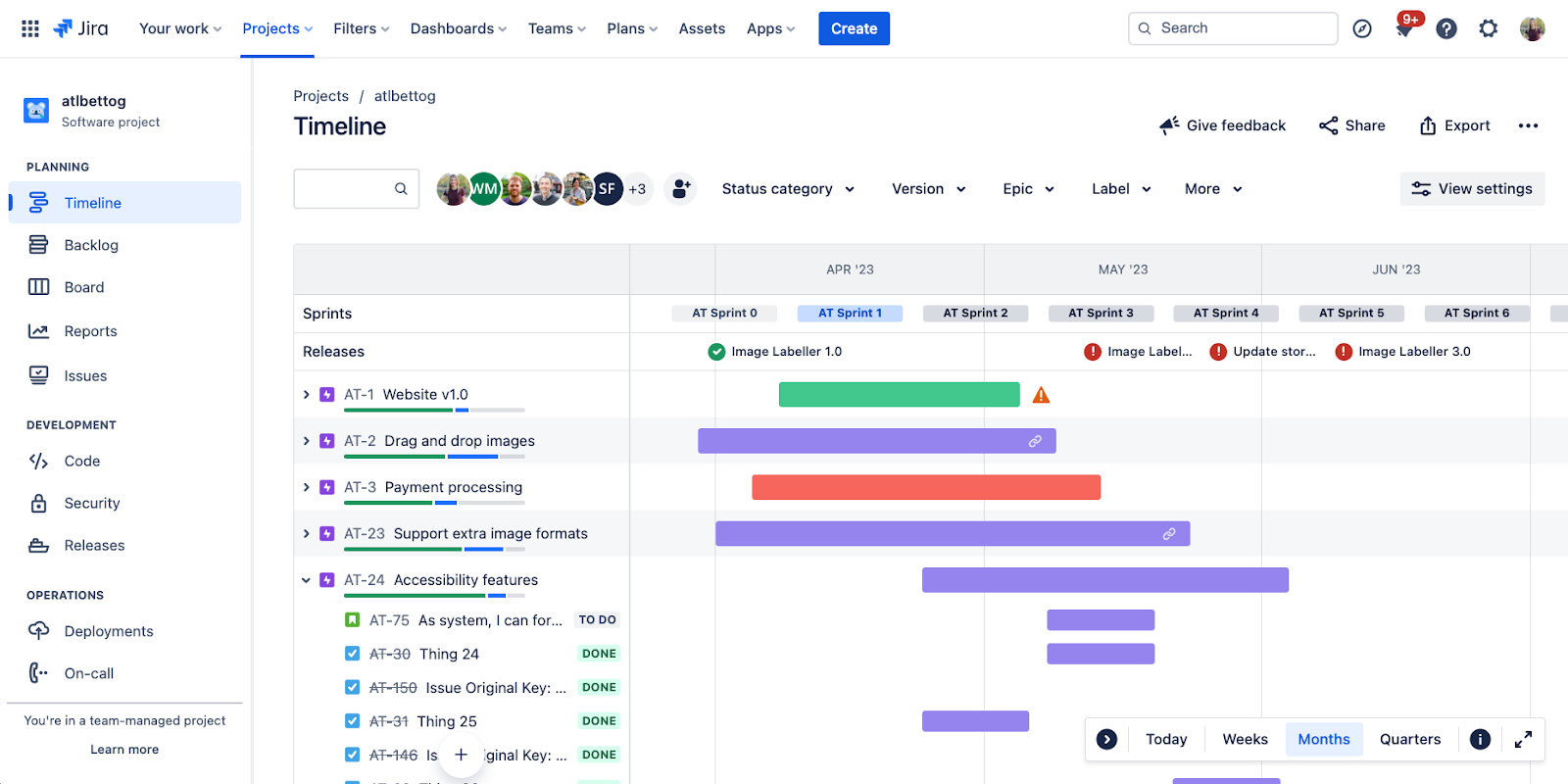
Manage large, cross-functional efforts, such as a program or initiative. The Jira top-level planning template gives you a plan that visualizes everything in one place, teams can easily track and report on work spanning multiple projects and understand how their work rolls up to the big picture.
Use your project scope statement to keep your eye on the prize
To define and manage project scope effectively, be precise. Clearly outline what is and isn’t included to avoid confusion.
Make sure you engage your team and collaborate to ensure your scope is realistic and comprehensive.
Prioritize objectives and leverage past projects to establish deliverables first, then set timelines and budgets, while reviewing previous outcomes to identify best practices. Maintain your scope statement in your Jira, so your team can easily reference what’s in—and out—of scope.
Recommended for you
TEMPLATE
Capacity Planning Template
Take the guess work out of your estimation and prioritization.
Confluence Templates
Browse our library of Confluence templates to help your team create, organize, and discuss work.